
 Language |
  English
 Spanish

Last week on Monday and Tuesday, approximately $300 billion was erased from software and data stocks during the trading sessions. A Jefferies trader coined the term “SaaSpocalypse,” describing trading as “very much ‘get me out’ style selling” of enterprise software companies’ shares. The cumulative damage from this indiscriminate selling during SaaSpocalypse over the preceding week exceeded $1 trillion across the software, data, and digital services ecosystem. The catalyst for the mayhem was Anthropic’s release of 11 open-source plugins for Claude Cowork on January 30, targeting legal, sales, marketing, finance, and data analysis workflows — the first time a major LLM provider moved directly into vertical enterprise applications. This has also led many to reassess a handful of other important risk factors at play today.
First, the justification for the selloff in shares of SaaS companies points to uncertainty about the sector’s future, with its valuation multiples likely to remain lower than the historical average (chart 1). However, the most critical risk in this current dynamic is the gap between infrastructure spending and realized AI revenue, all else being equal.

The scale of AI CapEx is creating unprecedented financing demands to the point that it’s already reshaping credit markets significantly. The tech sector debt issuance in 2025 alone was over four times its five-year average, with tech sector debt issuance expected to grow meaningfully in 2026 as well (chart 2 & 3).

*Oracle (ORCL) excluded — Q3 FY26 earnings expected week of Feb 10, 2026.
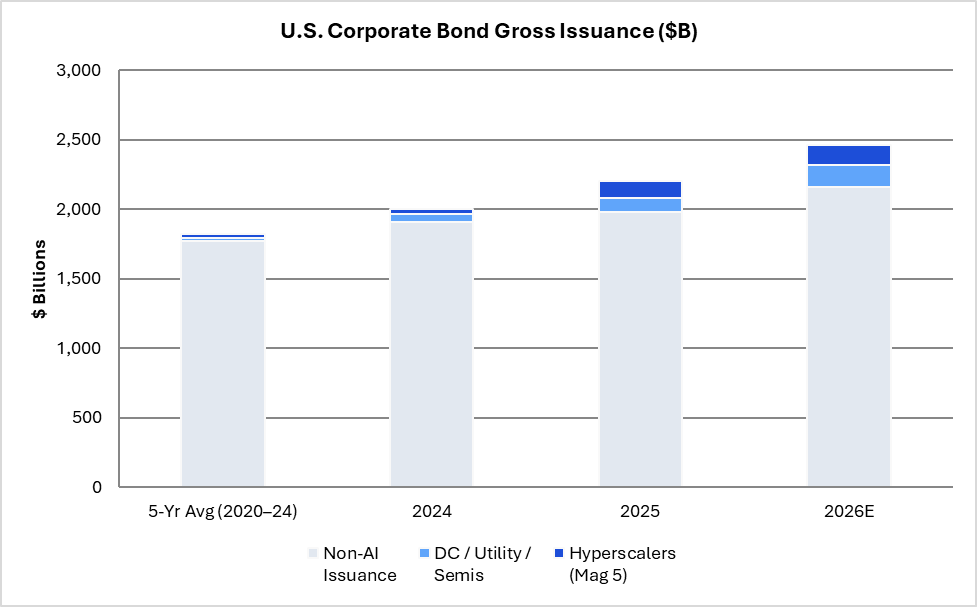
The magnitude of current AI infrastructure investment is without modern precedent. Aggregate CapEx for the Big Five, after buybacks and dividends are included, now exceeds projected cash flows, necessitating external funding from lenders. This gap is forcing hyperscalers into debt markets at an unprecedented rate and scale. Just today, according to Bloomberg, Alphabet has plans to issue 100-year corporate bonds, a first since the dot-com bubble in the ‘90s. Meanwhile, US corporate bonds on the whole offer very little to compensate for the risk (chart 4).

Special Purpose Vehicles (SPVs) have also moved billions in data center debt off corporate balance sheets. According to the Financial Times, Meta, Oracle, xAI, and CoreWeave have collectively moved over $120 billion in data center financing debt off their balance sheets using SPV structures, drawing in Wall Street banks and private credit firms as capital providers. This may introduce some opacity and contagion risks reminiscent of pre-2008 structured finance. For example, earlier today, reports surfaced about Apollo nearing a ~$3.4B debt deal with Valor Equity Partners for a Valor SPV to purchase Nvidia GB200 GPUs, which will in turn lease them to xAI under a triple net lease.
Lastly, Business Development Companies (BDCs) and many private equity firms face a dual threat: direct portfolio exposure to AI-disrupted sectors and indirect systemic risk from the AI financing ecosystem. According to UBS’s January 2026 report “Private Credit Outlook: Defaults, Disruption and Dispersion,” an estimated 25–35% of private credit portfolios face elevated AI disruption risk, with concentration mostly in technology (~24% of BDC holdings) and business services (~30% of BDC holdings). Whether losses from AI-disrupted sectors and gains from AI financing or vice versa end up as a wash is anybody’s guess.
One thing is clear though, the leading players in the AI race are becoming more systemically important in the US, akin to the largest banks in 2008. Given the importance of AI-related ROI materializing soon, all the added leverage and complexity may mean this new and steep uncertainty discount on SaaS is warranted today. However, whether this uncertainty discount should apply to every enterprise software company is likely an overreach, especially for companies with moats and deeper entrenchment in enterprises’ tech stacks.
The information contained in this article is for information purposes only, and represent the views of the author. It is not intended as specific investment or financial advice, or a recommendation or solicitation to buy or sell any security. Any investments or strategies listed in this article may not be suitable for all investors. Past performance is not indicative of future performance, and as with any investment, prices may fluctuate. It is recommended that advice is sought from a qualified investment professional prior to implementing any financial plan. LOM has made every effort to ensure that the contents herein have been compiled from sources believed reliable, however LOM does not warrant the accuracy, adequacy, timeliness, or completeness of this information expressly disclaims liability for errors or omissions in this information.
